
Building AI-ready manufacturing data requires moving beyond simple connectivity by implementing a unified namespace that provides essential OT contextualization for raw industrial signals. Manufacturers must standardize metadata and integrate disparate sources like SCADA and MES into a centralized architecture to ensure models have the semantic depth necessary for accurate analysis.
Most plant managers believe that simply moving data from the factory floor to a cloud data lake satisfies the requirements for industrial AI. However, this is a dangerous misconception that often results in expensive, stalled initiatives. Raw PLC tags without semantic context are essentially noise to a machine learning model; without the metadata that defines equipment relationships and operational states, your AI cannot drive predictive maintenance or process optimization. To bridge this gap, operations must shift from simple connectivity to deep OT contextualization. In this guide, we will analyze the metadata deficiencies inherent in legacy systems and detail how to architect a Unified Namespace using ISA-95 standards and MQTT Sparkplug B. You will learn to transform fragmented data streams into a structured, AI-ready foundation that achieves high analytics uptime without requiring a full rip and replace of your existing infrastructure.
The Connectivity Trap: Why Your Connected Factory Still Cannot Run AI
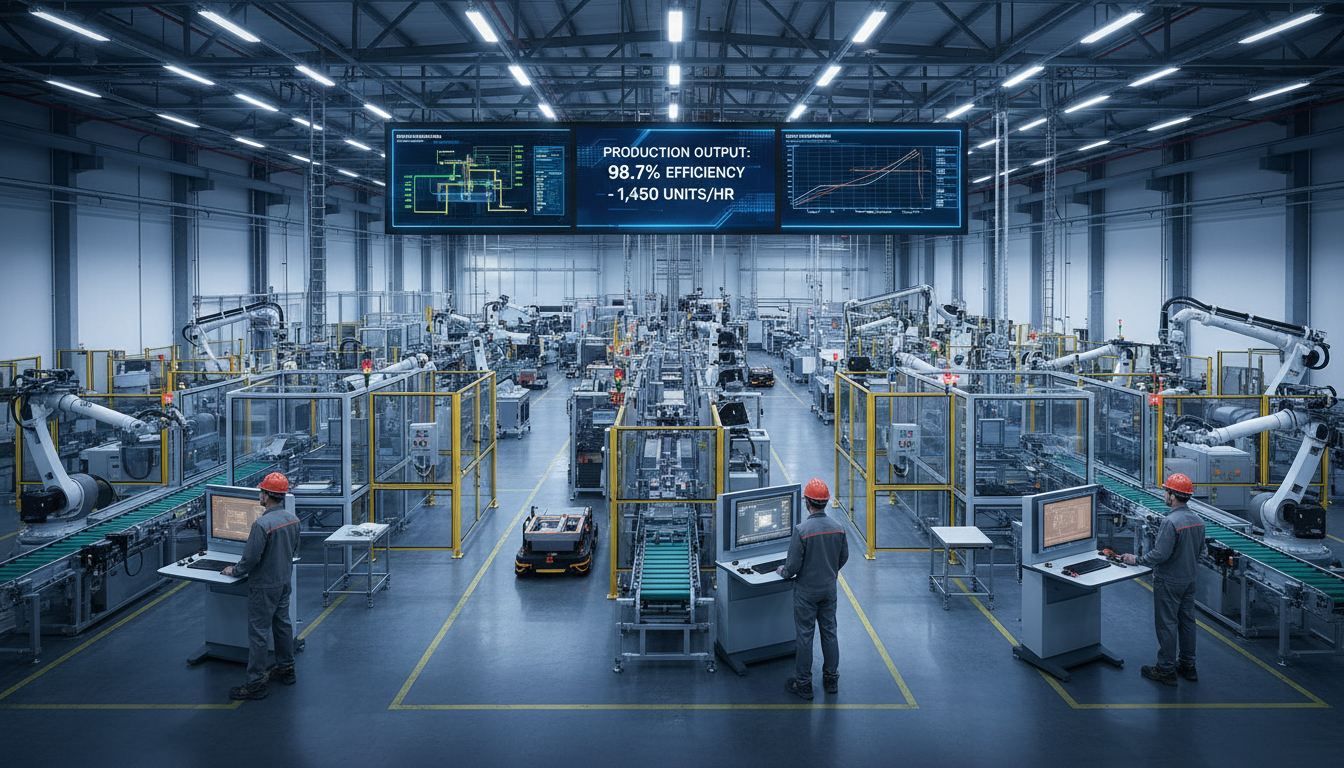
In the New Jersey industrial corridor, many manufacturing facilities have successfully transitioned from manual logging to digital data collection. They have installed gateways, wired their Programmable Logic Controllers (PLCs) to local SQL databases, and populated dashboards with real time metrics. However, a significant gap remains between a connected factory and one capable of supporting AI-ready manufacturing data. Connectivity provides the pipe; readiness provides the value.
The primary hurdle is the data quality crisis. Industry reports consistently show that 70 to 80 percent of industrial AI projects fail not because of weak algorithms, but because the underlying data lacks semantic meaning. To a data scientist or a machine learning model, a raw stream of PLC tags such as 'T4:0' or 'N7:10' is essentially dark data. Without a map to explain that 'T4:0' represents the dwell time on a specific injection molding press in a Parsippany facility, the data is noise.
Simply pushing raw bits to the cloud does not enable predictive maintenance on legacy equipment. Modern AI infrastructure requires context, such as which operator was logged in, what part number was in production, and what the ambient humidity was at that exact timestamp. Without this metadata, factories are stuck in a cycle of collecting dirty data that cannot be analyzed. Bridging this gap requires a sophisticated approach to industrial operations and AI infrastructure that prioritizes data architecture over simple hardware installation. Through strategic technical procurement services, firms can move beyond mere connectivity to achieve true operational intelligence.
What is AI-Ready Manufacturing Data?
To address the central question, "How do I make my data AI-ready?", operations managers must shift their perspective from "Big Data" to "Smart Data." While Big Data focuses on the sheer volume and velocity of information stored in a massive data lake, Smart Data is high-fidelity, properly labeled, and ready for immediate consumption by machine learning models. AI-ready manufacturing data requires a specific architecture built on three primary pillars.
First is Synchronicity. Industrial AI requires low latency. While batch processing is sufficient for historical reporting, predictive models rely on real time streams. If a machine learning model receives vibration data five minutes after a bearing fails, the opportunity for intervention is lost. A synchronized data stream ensures that high frequency sensor data is time aligned across the entire line, allowing the model to correlate events as they occur.
Second is Governance. This involves moving beyond localized, cryptic naming conventions. Data governance establishes a standardized dictionary for every asset. Instead of disparate tags like "MTR_1" or "Motor_A," governance enforces a uniform naming structure across the enterprise. This ensures that an AI model trained on one injection molding machine in a Parsippany facility can be deployed across a global fleet without manual re-mapping.
Third is Contextualization. This is the process of linking raw sensor readings to the physical asset hierarchy. A temperature spike is just a number until it is linked to a specific motor, on a specific production line, during a specific work shift, producing a specific SKU.
Dimension | Big Data (Legacy) | Smart Data (AI-Ready) |
|---|---|---|
Frequency | Asynchronous / Batch | Real-time / Event-driven |
Naming | Cryptic PLC tags (e.g., N7:0) | Standardized Hierarchies |
Structure | Unstructured Flat Files | Contextualized Data Objects |
Primary Use | Historical Auditing | Real-time Uptime Analytics |
Establishing these pillars transforms a factory from a state of passive recording to active intelligence. By prioritizing these dimensions, manufacturers ensure that their industrial operations and AI infrastructure investments yield actionable insights rather than digital noise.
Diagnosing the Metadata Gap in Legacy PLC Systems
The friction between vintage shop floor hardware and modern machine learning stems from a fundamental design conflict. Legacy controllers from manufacturers like Allen-Bradley, Siemens, and Schneider Electric were engineered for deterministic logic and high speed control, not for outbound data analytics. Their memory registers are often cryptic, storing values in registers like B3:0 or DB1.DBX0.0 that lack any inherent descriptive quality. This structural limitation creates the Metadata Gap, a void where the physical signal exists but its operational significance is lost.
In a typical North Jersey facility, a PLC might record a motor current spike with perfect accuracy. However, without a bridge to the broader business logic, the system cannot identify if that spike occurred during a routine startup, a specific SKU changeover, or while a particular operator was running the line. AI-ready manufacturing data requires this missing context to differentiate between normal variance and an impending failure. Bridging this gap is not about replacing the controller; it is about implementing sophisticated industrial operations and AI infrastructure that can wrap raw PLC tags in a layer of semantic meaning. By addressing this disconnect through specialized technical procurement services, manufacturers can enable predictive maintenance on legacy equipment without the prohibitive costs of a complete system overhaul.
The Unified Namespace: The Architectural Backbone for AI Uptime Analytics

Resolving the metadata gap requires moving beyond fragmented, point to point integrations that characterize legacy automation. The Unified Namespace (UNS) serves as the architectural backbone for this transition, transforming raw signals into AI-ready manufacturing data. While traditional industrial architectures follow a rigid, top down hierarchy, the UNS flattens the enterprise into a single, cohesive environment where data from the shop floor and the front office coexist in a standardized format.
In a typical ISA-95 or Purdue Model environment, data must travel through multiple layers, from the PLC to the SCADA system, then to the MES, and finally to the ERP. At each transition, context is often stripped away or delayed. A UNS architecture functions as a middleware scaffold that bypasses these bottlenecks. It acts as a centralized broker where every asset, from a vibration sensor to a work order database, publishes its information to a specific, named location. This ensures that every data point is addressable, discoverable, and contextualized in real time without requiring custom code for every new connection.
This flattened structure is the primary driver for real time uptime analytics. When a machine state changes, that event is immediately broadcast across the namespace. Because the UNS provides a single source of truth, an AI model can instantly correlate a motor temperature increase with the current production rate and the remaining life of the component. This level of visibility is essential for predictive maintenance on legacy equipment, as it allows operators to see the health of the entire facility through a single lens.
Feature | Traditional ISA-95 | Unified Namespace (UNS) |
|---|---|---|
Data Structure | Siloed and Hierarchical | Flat and Unified |
Communication | Point to Point / Request-Response | Hub and Spoke / Publish-Subscribe |
Data Access | Hard-coded Integrations | Open Access via Namespace |
Latency | High (Batch/Polling) | Low (Event-driven) |
Implementing a UNS through strategic technical procurement services allows manufacturers to decouple their data producers from their data consumers. This flexibility ensures that as your industrial operations and AI infrastructure grows, new sensors or analytical tools can be plugged into the existing scaffold without disrupting production. By organizing data into a semantic hierarchy, the UNS ensures that the shop floor is no longer a collection of isolated machines, but a transparent, data driven ecosystem.
Standardizing Equipment Hierarchies with ISA-95 and MQTT Sparkplug B
Building a Unified Namespace requires a logical structure that the entire organization can understand. We recommend adopting the ISA-95 functional model to define your equipment hierarchy. While the Purdue Model is often cited in discussions regarding network security and segmentation, ISA-95 provides the necessary framework for data organization. By mapping every asset to a standard path, such as Enterprise, Site, Area, Line, and Cell, you ensure that a sensor reading is no longer an isolated event but a piece of a larger operational puzzle. For a facility in North Jersey, this means a motor vibration sensor is identified as `LebronIndustrial/Parsippany/Packaging/Line4/ConveyorMotor1` rather than a cryptic address.
To transport this structured data into AI-ready manufacturing data pipelines, MQTT Sparkplug B is the industry standard protocol. Unlike raw MQTT, which is a payload agnostic transport, Sparkplug B enforces a consistent topic namespace and data model. It provides state management, ensuring the system knows if a device is offline, and utilizes Birth Certificates for devices. These certificates allow legacy controllers to announce their capabilities and data types automatically to the broker.
Level | Description | Example (Parsippany Site) |
|---|---|---|
Enterprise | The highest organizational level | Lebron Industrial |
Site | Physical location of the facility | Parsippany-Troy Hills |
Area | Functional production zone | Bottling Department |
Line | Specific production sequence | Line 02 |
Cell | Individual machine or asset | Palletizer 4A |
This self-describing nature is critical for industrial operations and AI infrastructure; it eliminates the need for manual configuration every time a new data point is added. By using Sparkplug B, manufacturers can wrap legacy signals in a rich metadata envelope, facilitating seamless integration with cloud analytics. Through disciplined technical procurement services, teams can select gateways that natively support these protocols, ensuring long term scalability for predictive maintenance on legacy equipment.
Building the PLC to Cloud Bridge Without Rip and Replace

Transitioning from a logical hierarchy to a physical implementation often sparks concerns regarding high capital expenditure. Many plant managers in the North Jersey industrial corridor hesitate to pursue digital transformation due to the perceived cost of replacing functional, 20 year old machinery. However, achieving AI-ready manufacturing data does not require a total rip and replace strategy. By utilizing modern IIoT gateways as an intelligent edge layer, we can extract raw registers from legacy controllers and map them directly into a Unified Namespace.
Lebron Industrial Operations & AI specializes in designing these non-intrusive data pipelines. Through targeted technical procurement services, we identify the specific hardware, such as edge compute gateways or protocol converters, capable of speaking legacy languages like Modbus or Serial while outputting MQTT Sparkplug B. This approach transforms an aging injection molder or packaging line into a sophisticated data producer. By injecting semantic context at the source, legacy assets can feed the same high-fidelity machine learning models used in modern greenfield facilities. This strategy facilitates predictive maintenance on legacy equipment without the prohibitive cost of new capital assets. Our focus on industrial operations and AI infrastructure ensures that existing shop floor hardware becomes a competitive advantage, bridging the technical debt between legacy controls and modern cloud analytics.